Why Count at the Exit
A roost exit count is the most direct measurement available for a bat colony's size. At the moment of emergence, every individual in the roost passes through a bounded point in space. If that point can be observed completely, the count is exact.
This survey method underpins legal assessments in most European jurisdictions. Where a roost is at risk from development, renovation, or management activities, regulators require a count that demonstrates how many bats depend on that roost. Presence alone is not sufficient: a single bat detected acoustically could represent a transient individual. A count at the exit establishes the scale of the population at that specific structure.
Ecologists have long performed emergence counts manually, with an observer stationed near the exit in the half-hour around sunset. The method works, but it has limits: a single observer can miss simultaneous exits, fatigue accumulates across long emergence events, and the count is not timestamped at the individual level. The record is a single number, not a structured dataset.
A count at the exit establishes the scale of the colony. Every individual that leaves the roost passes through the same point.
Thermal video positioned at the exit transforms this situation. The camera records every individual that crosses the exit plane. The count is no longer an observer's estimate.
What Exit Counting Captures
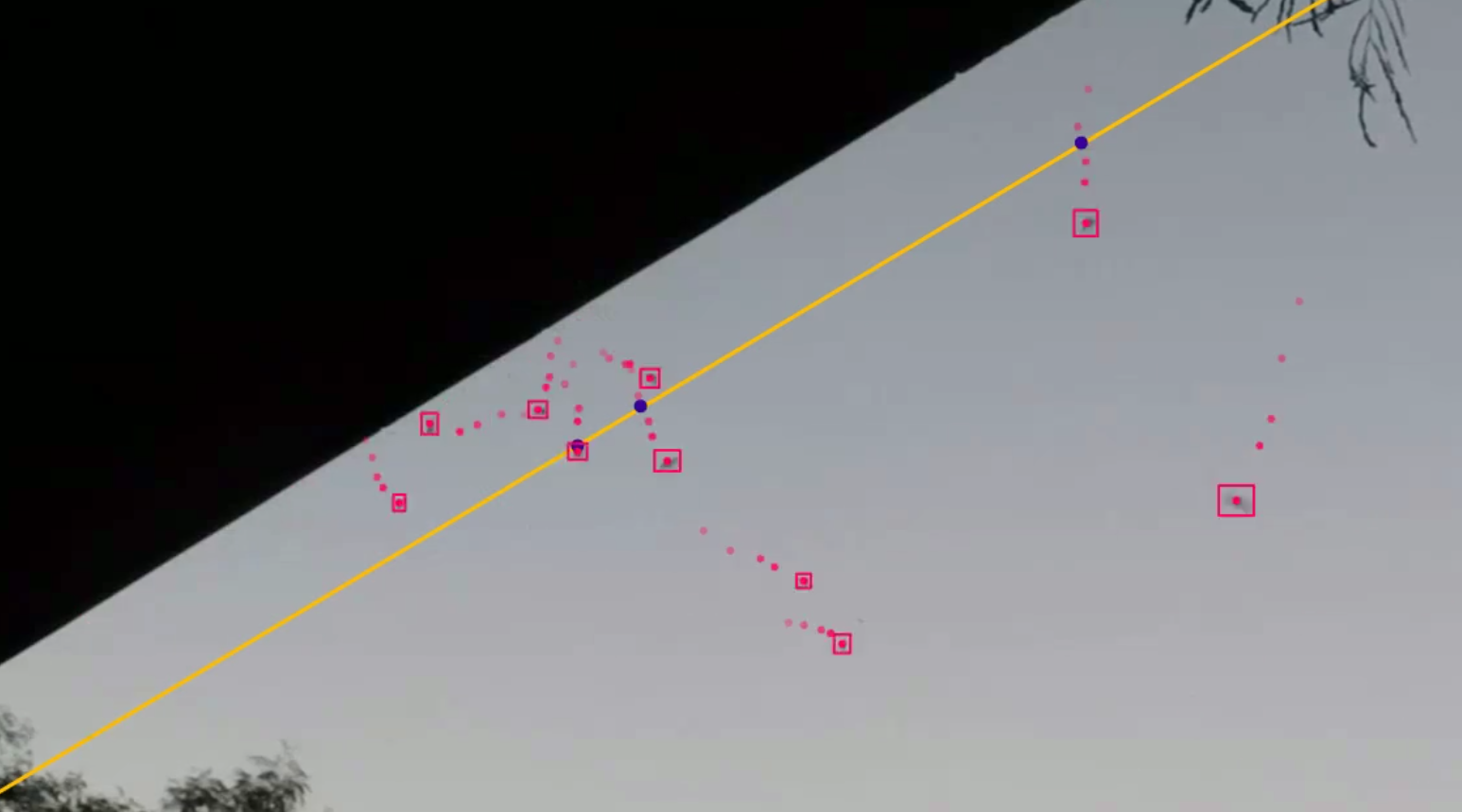
A well-executed exit count with TrackBats produces more than a total. For each bat crossing the virtual counting line placed at the exit, the system records:
- Crossing time The exact frame and clock time at which each individual crossed the exit line, giving a full temporal distribution of the emergence.
- Direction Whether the bat was exiting or entering. Re-entries are recorded separately and can be subtracted from the gross count to give the net number of distinct individuals that left the roost.
- Session total The cumulative count across the full recording session, corrected for re-entries and validated tracks.
Challenges at the Exit Point
Exit counting is conceptually simple but practically demanding. The exit point is a constrained space through which the colony passes in a short window of time. Several situations require careful handling.
Simultaneous exits
Multiple bats leaving at the same moment create overlapping thermal signatures. The tracker must separate them as distinct individuals rather than counting them as one.
Re-entries
Some individuals exit and return before the main emergence is complete. Re-entries must be identified by direction of crossing and excluded from the net count.
Partial occlusion
Vegetation, structure, or camera angle can obscure part of the exit. Bats that clip the edge of the frame may be missed or tracked incompletely.
False detections
Insects, leaves, and thermal reflections can trigger the detector. The track review step allows spurious detections to be removed before export.
TrackBats addresses these challenges by combining automated tracking with a structured review interface. The ecologist does not watch the entire video: they review the list of detected crossings, confirm or exclude each one, and export a validated count.
Automating the Count with TrackBats
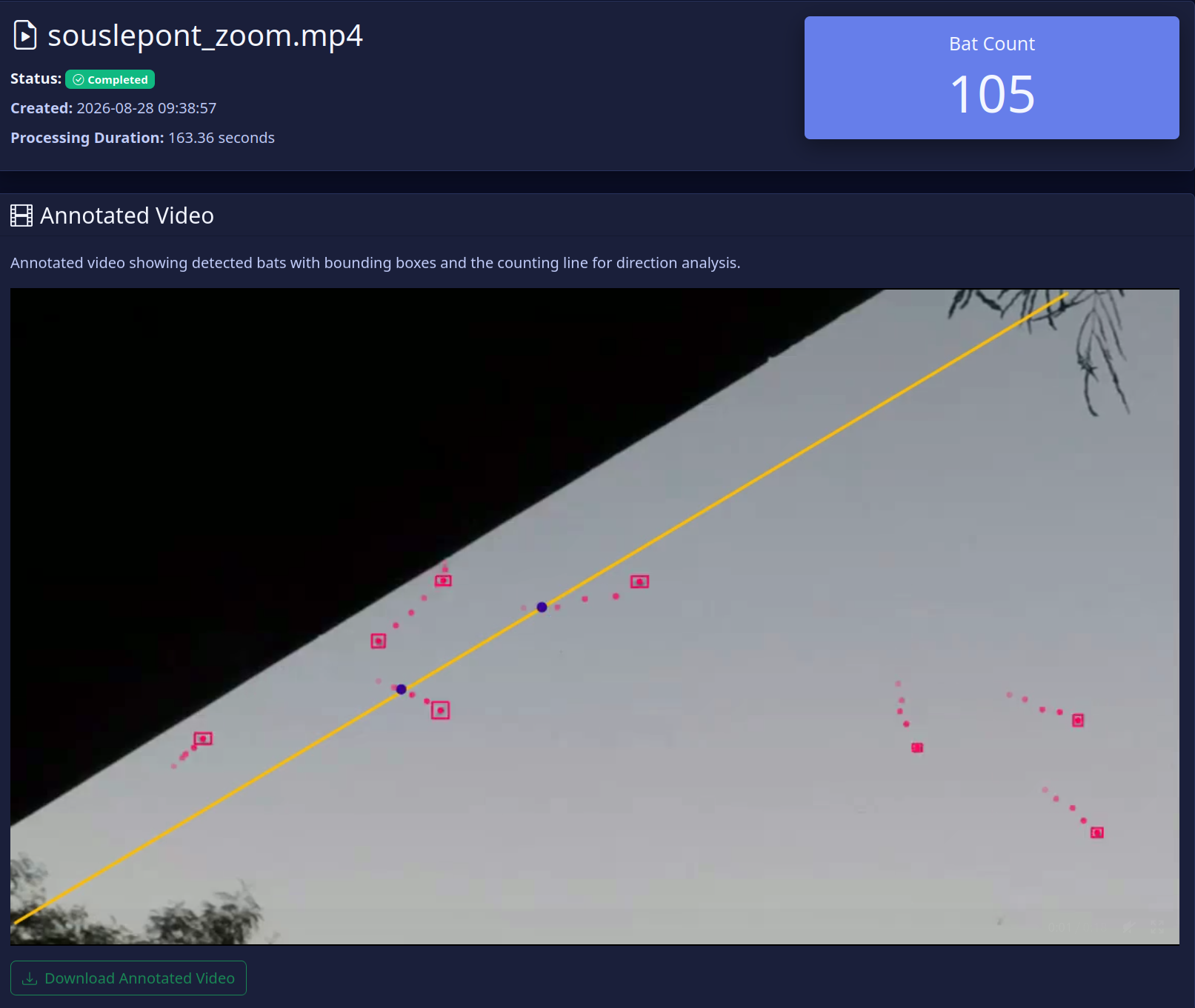
The counting workflow in TrackBats is built around a configurable virtual segment placed across the exit in the video frame. Once the segment is positioned, the system tracks all detections in the video and logs each confirmed crossing with its direction and timestamp.
Segment placement
The counting segment is placed in the TrackBats Studio, drawn across the exit aperture before processing begins. Its position determines what counts as a crossing: a bat that passes fully through the segment is logged; one that grazes the edge without completing the crossing is not.
Track-based counting
Each crossing is associated with a full reconstructed track, not just a detection event. This means the ecologist can inspect the flight path of every counted individual, confirm it represents a real bat, and see exactly when and how it passed the exit.
Direction filtering
The system records crossing direction for each track. Exit crossings and entry crossings are reported separately. The net count, distinct individuals that left the roost during the session, is derived by subtracting confirmed re-entries from the gross exit total.
Reading the Emergence Profile
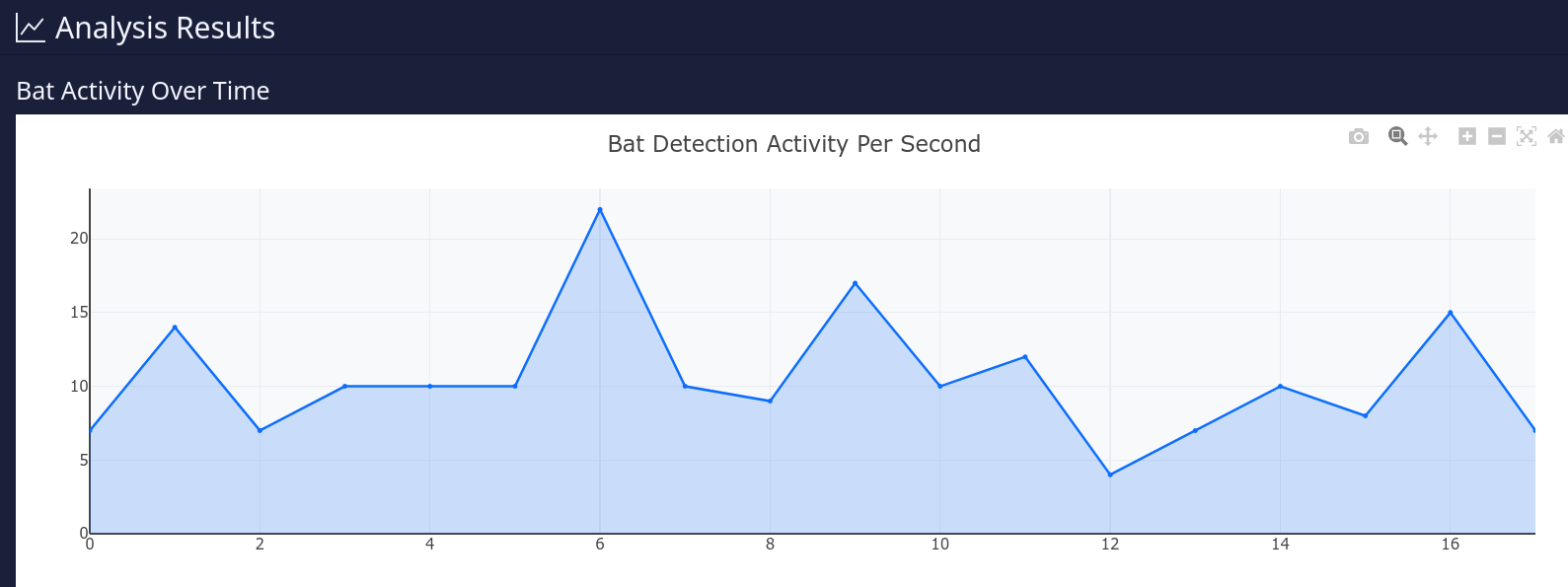
The temporal distribution of crossings across the emergence window is itself an ecological signal. A colony that emerges in a dense burst over five minutes is behaving differently from one that trickles out across forty minutes. The difference can reflect species, colony composition, weather conditions, or the structure of the roost.
TrackBats records a timestamp for every crossing. This makes it straightforward to plot the emergence profile: how many bats left per minute across the session. Peak emergence time, relative to sunset, is a standard metric in roost assessment and can be tracked across multiple survey visits.
Across multiple sessions at the same roost, emergence counts reveal seasonal patterns: the build-up to maternity peak, the post-weaning dispersal, and the autumnal decline. These patterns are population indicators that complement the single-night count required for a legal assessment.
Going Further with Track Data
An exit count answers the question of how many bats left the roost. The tracks recorded during the same session can answer what those bats did immediately after leaving. Where did they fly first? Did they follow a consistent route away from the exit, or disperse in multiple directions? Did any individual return and forage near the roost before committing to departure?
These questions matter for habitat management advice. If the post-emergence flight consistently follows a specific hedgerow, that linear feature is part of the roost's functional habitat. An exit count alone would not reveal this.
The track analysis tools in TrackBats process the same video that produced the exit count, so both layers of information are available from a single recording session.
Continue reading