The Complementarity Problem
Thermal infrared video and acoustic monitoring have, until now, existed as parallel methodologies in bat survey practice. Each has well-defined strengths, and each has a well-defined limitation that the other addresses.
Acoustic monitoring identifies species. Bat echolocation calls carry species-specific signatures: pulse structure, characteristic frequency, call duration, interpulse interval, that experienced analysts and automated classifiers can use to determine which species produced a call. For many survey purposes, species identity is the primary output required: which species are present, at what activity levels, and with what seasonal patterns.

But acoustic monitoring cannot tell you what the bat was doing. A contact in a static detector log is a point in time with no spatial or behavioural context. Multiple species calling simultaneously produce overlapping recordings that are difficult or impossible to attribute to individuals. And in situations where bats are not calling actively (or where call characteristics are ambiguous) identification fails.
Thermal video does the opposite. It shows you exactly what each bat is doing: its position, trajectory, speed, and behaviour, but it carries no species information whatsoever. A pipistrelle and a noctule flying side by side look identical in thermal imagery: two bright objects against a dark background, differing only in size.
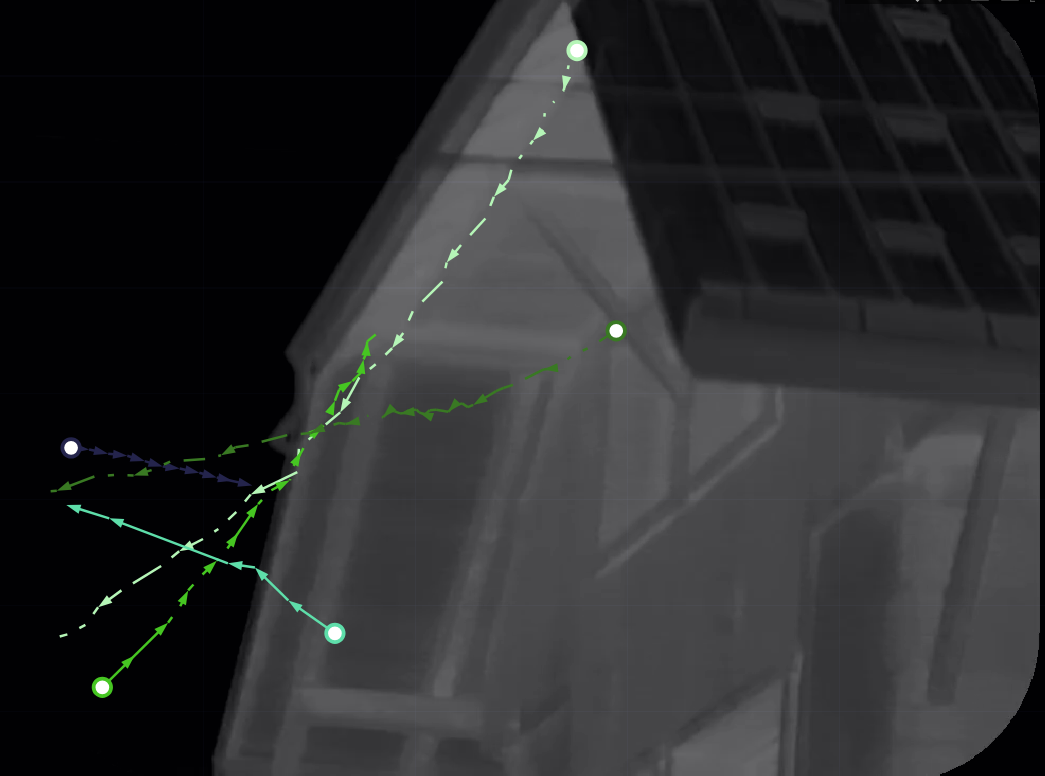
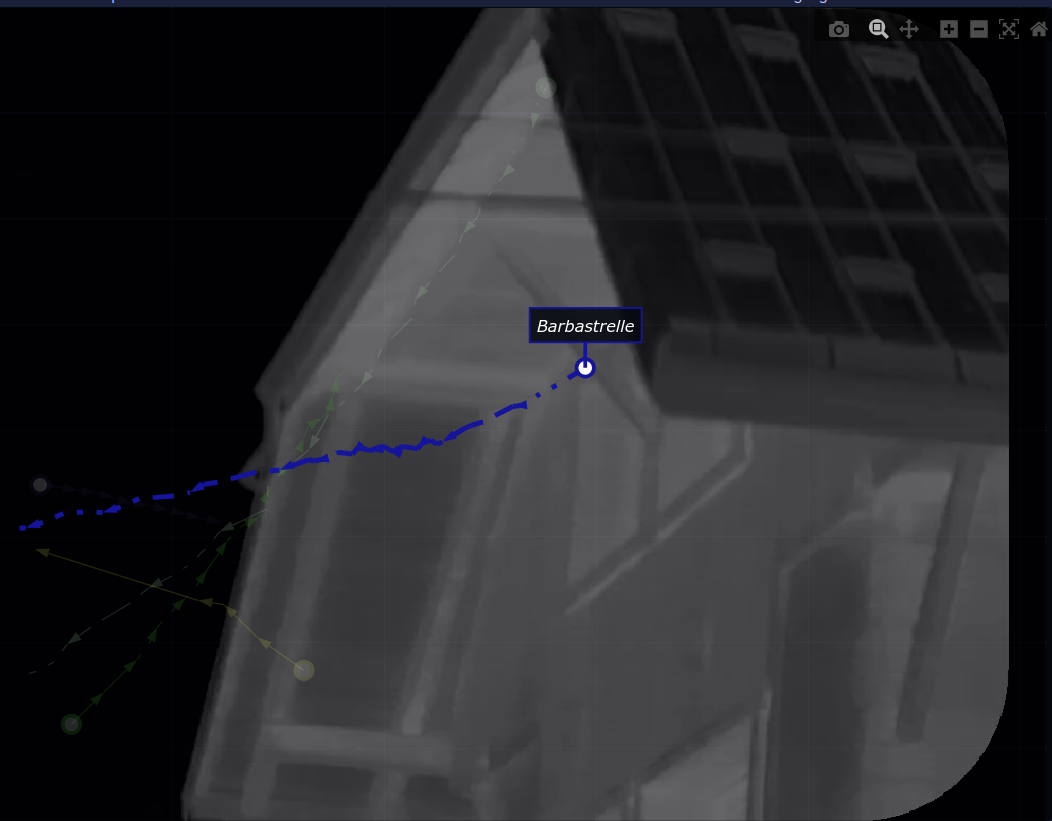
The acoustic recording provides species identity; the thermal track provides spatial and behavioural context.
The combination of the two methods, synchronised acoustic recording matched to individual thermal tracks, has long been recognised as the logical solution. Together, they give what neither can provide alone: a record of which species flew where, doing what, at what time.
This combination is what TrackBats is building toward with its acoustic coupling feature.
How Acoustic Coupling Works
The core challenge of acoustic coupling is attribution: matching a recorded call to the individual bat that produced it.
In a simple scene with very few bats, this is trivial: any call recorded during the bat's presence in the field of view was probably produced by that bat. In a crowded scene with many bats flying simultaneously, attribution becomes a genuine scientific problem. Multiple individuals may be calling simultaneously; calls may overlap; some bats may not be calling at all at a given moment; and the spatial resolution of most acoustic detectors is insufficient to distinguish calls from nearby individuals.
TrackBats approaches this problem by combining synchronised timing, spatial proximity, and AI-based acoustic classification:
- Synchronisation The acoustic recorder and the thermal camera are synchronised to a common time reference. This allows calls to be associated with the subset of bats visible in the thermal video at the moment of recording.
- Spatial filter For each recorded call, the thermal tracks active at that moment are identified. Calls are attributed preferentially to the bat whose trajectory is most spatially consistent with the likely call origin, taking into account the position of each bat in the frame.
- Classification Each attributed call sequence is passed through an AI species classifier trained on bat echolocation calls. The classifier produces species probabilities for each call, which are associated with the corresponding thermal track.
- Track label Where a bat produces multiple calls during its time in the field of view, the species assignments from each call are combined into a track-level species probability. Tracks with high classification confidence receive a definitive species label; tracks with ambiguous calls are flagged for manual review.
The result is a track list in which each individual bat trajectory is annotated with its most probable species identity: a dataset that did not exist before, and that neither thermal nor acoustic monitoring could produce independently.
What This Enables
The fusion of individual-level trajectory data with species identity opens analytical possibilities that are genuinely new in applied bat ecology.
Species-specific corridor use
Rather than knowing that a hedgerow is used by bats, it becomes possible to know that it is used predominantly by common pipistrelles commuting at 3–5 metres height, with occasional soprano pipistrelle transits at a higher level, and rare noctule passes crossing rather than following the feature. This level of detail is directly relevant to impact assessment and mitigation design.
Species-specific activity budgets
The proportion of time each species spends in transit versus foraging flight, the spatial distribution of foraging activity by species, and the temporal overlap between species at shared features all become quantifiable from a single recording session.
Exit count attribution
At a roost with mixed species composition, a common scenario in urban and suburban contexts, thermal exit counting combined with acoustic coupling can apportion the total emergence count between species. This has obvious value for roost characterisation and for assessing the impact of works on a roost of mixed or uncertain species composition.
Population monitoring
Where the same site is surveyed across multiple seasons or years, species-attributed track data provides a richer basis for trend assessment than count data alone. Changes in species composition, flight line use, or foraging behaviour over time may signal ecological changes that count-based monitoring would not detect until much later.
Practical Deployment
Deploying acoustic coupling in the field requires a modest addition to standard thermal video survey methodology.
A bat detector or full-spectrum recorder is positioned at or near the camera, oriented to cover the same field of view as the thermal sensor. The choice of microphone type, omnidirectional versus directional, depends on the complexity of the scene: in simple scenes with few simultaneous bats, an omnidirectional detector is sufficient; in dense, multi-species scenes, a directional microphone oriented parallel to the camera axis improves attribution accuracy.
Time synchronisation between the recorder and the camera can be achieved by a simultaneous clap or tone at the start of the recording, by GPS-disciplined time references on both devices, or by dedicated synchronisation hardware. TrackBats accepts standard full-spectrum audio formats and performs synchronisation automatically given a common time reference.
The acoustic files are uploaded to TrackBats alongside the thermal video, and the coupling analysis runs as part of the standard processing pipeline. No specialist acoustic analysis software is required; species classification is performed automatically, with results integrated directly into the track export.
Current Status and Roadmap
Acoustic coupling is an active area of development in TrackBats. The thermal detection and tracking pipeline (the foundation on which attribution is built) is already in production. The acoustic classification model, trained on a large corpus of European bat calls, is under development. Integration of the full coupling pipeline into the TrackBats platform is the next development milestone.
For ecologists and researchers who want to be among the first to use this capability, particularly those working with challenging multi-species sites, high-density roosts, or research questions that require individual-level species data, we welcome early collaboration. If you have synchronised thermal and acoustic recordings from bat surveys, we would be glad to discuss how your data could contribute to validation and what the analysis could offer you in return.
The goal is a workflow that is as accessible as standard acoustic monitoring: upload your files, receive your results. But one that delivers a quality of spatial and species-level information that no previous survey method has been able to provide.
A Note on Limitations
Honest assessment of a method's limitations is part of good ecological practice, and acoustic coupling is no exception.
Attribution confidence decreases with scene density: in very crowded scenes where many bats are calling simultaneously, the probability of correctly attributing a call to the right individual decreases. TrackBats provides confidence scores with each attribution, allowing analysts to apply appropriate thresholds for their purposes.
Species identification from echolocation calls is inherently probabilistic for some species pairs, such as the pipistrelle complex or the Myotis genus, where call characteristics overlap. Acoustic coupling does not resolve this fundamental ambiguity; it inherits it. Where call-based identification is uncertain, track-level species labels reflect that uncertainty.
These limitations are shared with all acoustic monitoring approaches. Acoustic coupling adds species information to thermal tracking where the acoustic signal is present and attributable; where it is not, thermal tracking still delivers the full suite of spatial and behavioural data that makes it valuable in its own right.
Continue reading